
Plato’s Academy began as a highly selective boys’ club. Education has thankfully become more accessible. But we have a lot of work to do. My latest project, plato, aims to give more people access to dynamic learning opportunities.
The Backstory
In 1959, a computer science professor at the University of Illinois Urbana-Champaign built the first computerized tutor. By programming literacy lessons, the professor aimed to make more people literate.
The computer was called PLATO — Programmed Logic for Automatic Teaching Operations. PLATO introduced touchscreens, online forums, multiplayer games, and instant messaging. More importantly, much online learning can be rooted in PLATO.

The problem with static content
PLATO found success building static content programs that pushed people to single outcomes. But static content needs to be constantly updated.
This year, I have been building AI Leaders, an AI Literacy course built to give people real, living-wage skills.
While I’ve been building it, something has bothered me.
AI is not a static subject. It changes week to week. Models improve. New tools emerge. Topics that mattered six months ago are already outdated. And yet most online courses work like textbooks. You write the content, you publish it, and it sits there aging.
That is the wrong model for teaching AI.
I also noticed that student interests shift. Some people hope to unlock creative passions. Others just care about getting jobs. A single fixed curriculum cannot serve eveyone well.
So a team of educators, technologists, and I started exploring: what would a classroom look like if it actually adapted – to the subject, to the student, and to the moment?
A Generative Education Platform
From Khanmigo to Magic School, I’ve worked with a lot of AI-powered platforms. All those platforms were too rigid, too expensive, or built on assumptions that made sense for static content but broke down for something as dynamic as AI literacy.
So, I built a truly generative platform from scratch.
Enter “plato.”

The platform lives at github.com/1111philo/plato and it is Open Source, meaning anyone can use or update it.
Working with other 11:11 Philosophers I explored the idea that learning should be generative, not static. plato uses AI to create and adapt course content based on what is happening in the field and what individual learners are actually interested in. Instead of a fixed syllabus, there is a living curriculum. Instead of a single path, there are paths shaped by each learner’s goals and prior knowledge.
At the center of plato is a learning loop, rooted in Learning Sciences. The learner is given activities by an AI coach, who constantly assesses their work as they move to a course exemplar. If the learner doesn’t grasp a concept, the coach offers questions that moves them closer to the exemplar.
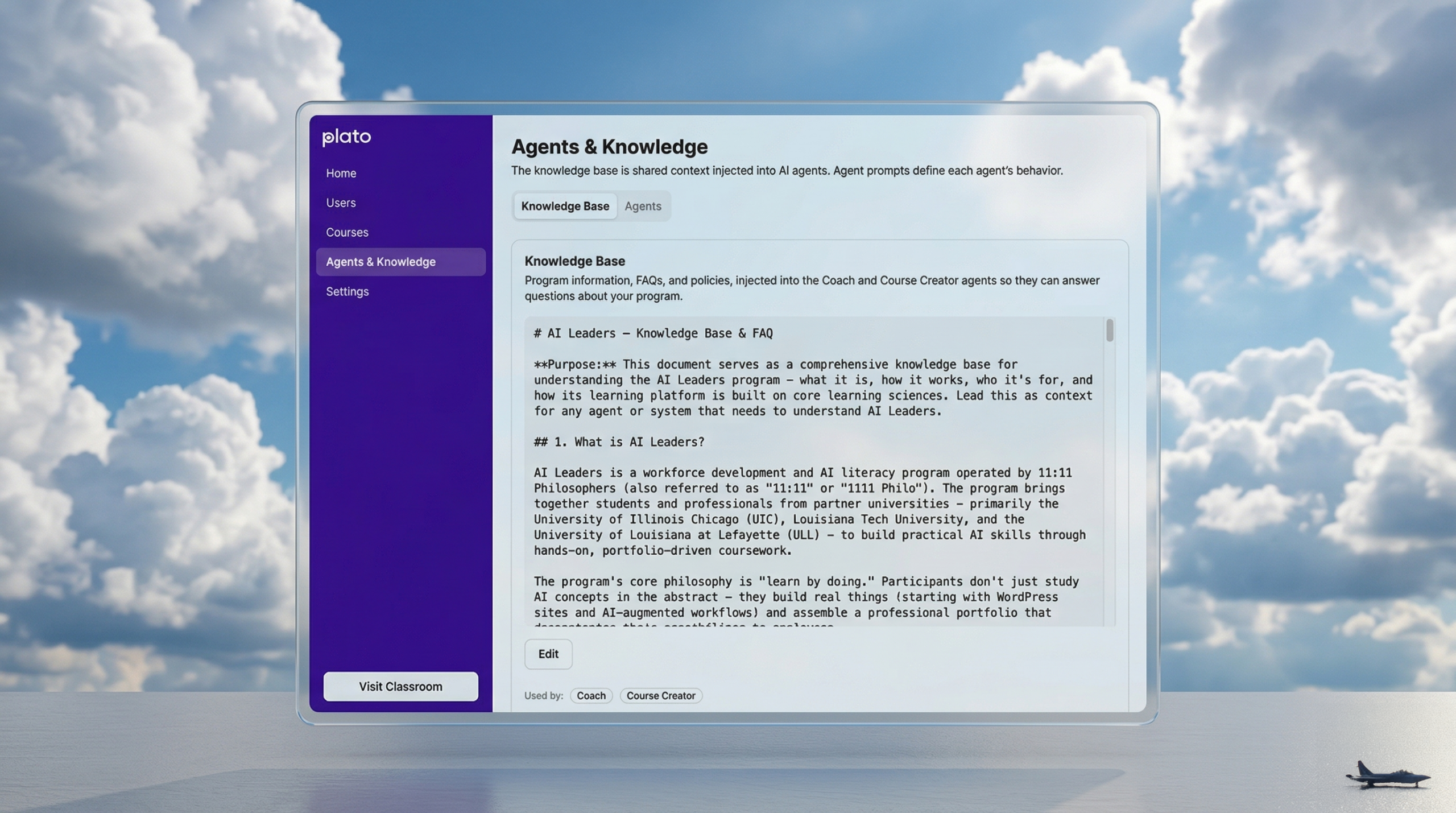
Educators can constantly tune the system by changing agent prompts, updating a knowledge base, or creating new courses. Each learner gets a little different experience, but the system makes sure every student reaches the Educator’s end goal.
plato’s Moment
PLATO — the original one — showed up sixty years too early. The hardware was not ready. The networks were not there. The culture had not caught up.
Now, I’m betting that AI can help us scale education to a whole new generation of learners.
If you are a developer, an educator, or someone who cares about what learning looks like in the next decade, I would love for you to take a look at the repository or get in touch with me.
Like knowledge, plato belongs to everyone.
Leave a Reply