• Disrupting the Disruptors

    Workforce development has far stronger causal evidence for investment than investing in entrepreneurship does.

    Most conversations about economic investment start with entrepreneurship. New companies, new jobs, new disruption. It is the dominant frame in policy, philanthropy, and platform economics. Universities build incubators. Cities fund accelerators. Foundations back founder cohorts. The assumption underlying all of it is that backing entrepreneurs is how you grow an economy.

    The evidence does not support that assumption. And the contrast with what the evidence does support is stark enough that it should change how serious investors think about economic development.


    What the evidence actually shows

    For the past four decades, economists have subjected workforce development programs to some of the most rigorous evaluation in social science. Randomized controlled trials — the same evidentiary standard used to approve pharmaceutical drugs — have measured the causal impact of training programs on earnings, employment, and economic mobility with precision that almost no other investment category can match.

    The results are extraordinary. Year Up, a sectoral training program placing low-income young adults into corporate IT and financial services roles, produced a 30% increase in annual earnings sustained through year seven — the largest earnings gain ever documented in a high-quality workforce RCT, according to the federally sponsored PACE evaluation conducted by Abt Associates for the U.S. Department of Health and Human Services. Per Scholas, which trains unemployed adults for technology careers at a cost of approximately $8,000 per participant, reports an 8 to 1 economic return according to its own annual data, while an independent ten-year randomized trial found cumulative earnings gains of roughly $42,000 against that cost. Project Quest, a healthcare and skilled trades program in San Antonio, was found in a 14-year randomized controlled trial by the Economic Mobility Corporation to have generated $54,000 in cumulative earnings gains per participant against an average investment of $16,244 — a 234% return, with participants moving from poverty-level wages to nearly $60,000 annually by the final year of the study. The Hendren and Sprung-Keyser welfare analysis published in the Quarterly Journal of Economics, which evaluated 133 historical policy changes using a unified framework, found that the best sectoral training programs more than pay for themselves through increased tax revenue and reduced transfer payments.

    Investing in Workforce Development is backed by the strongest causal evidence of any category of economic investment that I know of. Not the strongest in workforce policy. The strongest anywhere.


    Now look at what we have for entrepreneurship incubators

    The same Harvard framework that rigorously evaluated 133 government policy changes contains zero incubator or accelerator evaluations. Not because researchers tried and found no effect. Because the data required to measure them was never collected.

    The Kauffman Foundation, the largest private foundation dedicated to entrepreneurship research in the United States, examined more than 35 academic articles on incubators and concluded that they might not prove more effective at creating successful businesses than unincubated businesses. A 2024 study by Wharton professors Valentina Assenova and Raphael Amit, published in the Strategic Management Journal, examined data from 8,580 startups across 408 accelerators in 176 countries and found that accelerated startups were just 3.4% more likely to raise follow-on venture capital than unaccelerated ones.

    Meanwhile, more than 75% of venture-backed companies never return their investors’ capital, according to Harvard Business School senior lecturer Shikhar Ghosh’s research on more than 2,000 ventures. The top 10% of VC-backed companies generate approximately 90% of all returns, according to Commonfund’s analysis of 35 years of venture data. This power law concentration is known and accepted by venture capitalists — it is their operating model. But most institutional investors in entrepreneurship are not venture capitalists. They are universities, foundations, governments, and workforce programs funding cohorts as if each founder has roughly equal odds, with no portfolio logic and no rigorous outcome measurement.

    The accountability asymmetry is where this becomes a policy problem. Workforce programs funded under the federal Workforce Innovation and Opportunity Act must report against six standardized performance indicators using unemployment insurance wage records and independent administrative data. On the other hand, incubator and accelerator programs receiving equivalent public funds face no comparable requirements. Metrics are self-reported. Comparison groups are absent. Survivorship bias is endemic — programs report successful exits while failed ventures disappear from the data entirely.

    We hold workforce investment to some of the highest evidentiary standards in social science and give entrepreneurship investment a complete pass on sentiment alone.


    This is not an argument against entrepreneurship

    Joseph Schumpeter, the early twentieth century Austrian economist who gave us the concept of creative destruction, was right that entrepreneurship is the primary engine of long run economic growth. The evidence supports him at the macro level. And there are narrow conditions under which entrepreneurship investment is clearly the superior bet.

    NYU Stern professor Sabrina Howell found, in a quasi-experimental study of the Department of Energy’s SBIR grant program published in the American Economic Review in 2017, that an early-stage grant approximately doubles a startup’s probability of attracting subsequent venture capital, with large positive effects on patenting and revenue. These effects were strongest for financially constrained firms — the mechanism was funding technology prototyping, not certifying quality. Elite accelerators with intensive mentoring components produce measurable value when the program is genuinely selective and the mentoring is substantive.

    But Schumpeter’s own framework identifies the conditions under which disruption generates economic returns. The innovation has to be genuinely disruptive, not incremental. It has to create more than it destroys across the broader economy. And the economic cycle has to favor new disruption rather than the absorption of existing innovations. Most institutional investment in entrepreneurship fails all three tests. And there is no rigorous measurement infrastructure in place to know when it does and when it does not.


    What this means for anyone allocating capital toward economic impact

    Workforce development does not get the headlines. It does not produce unicorns. It does not generate the cultural narrative of the scrappy founder changing the world. But it reliably raises wages for people who need higher wages, generates returns that exceed its costs, and has been proven to do so across decades of independent evaluation.

    The programs that work share a common structure: they train for specific industries with documented labor shortages, they secure employer commitments before training begins, they provide wrap-around support for participants who face economic barriers, and they track outcomes rigorously over time. Year Up. Per Scholas. Project Quest. These are not experimental models. They are proven ones.

    The question for any institution — foundation, university, city government, platform company, ecosystem investor — that genuinely wants to produce economic impact is whether the investment they are making meets the evidentiary bar that workforce development has already cleared. Most entrepreneurship programs do not come close. If your goal is to make society measurably better, the evidence says invest in workforce development.


    Postscript

    Claude helped me form this article, but true credit should go to the Schumpeter chapter of The Worldly Philosophers by Robert L. Heilbroner. Heilbroner put Schumpeter into terms that made me instantly draw a dichotomy between VC and workforce investment. Claude then helped me build an app that used Schumpeterian calculus, which led to me finding very few instances where an investor should invest in Innovation versus iorkforce development.

  • plato’s Microlearning

    Bite-Sized but Whole: Applying Microlearning in plato

    Here at the 11:11 Philosopher’s Group, we’ve been exploring how learning should be generative, dynamic, and accessible to everyone. With the launch of plato, our open-source, AI-powered education platform, we are moving away from the “static content” models that age like textbooks.

    As we scale plato to support agentic classrooms, we must critically evaluate the instructional methods we use to power it. One of the most talked-about approaches today is microlearning—an instructional method that delivers targeted, action-oriented, bite-sized content designed to achieve specific objectives in a short timeframe.

    Microlearning has incredible potential, but like any tool, it must be wielded correctly. Here is how we should—and shouldn’t—apply microlearning within the plato ecosystem.

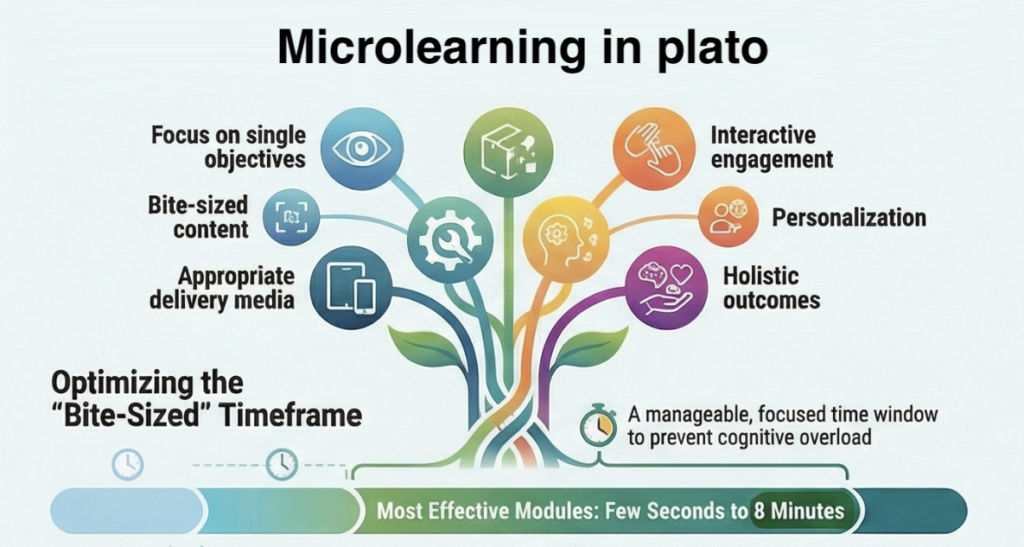
    Infographic titled "MICRO-LEARNING in PLATO." A tree graphic illustrates six characteristics of micro-learning: Focus on single objectives, Bite-sized content, and Appropriate delivery media on the left; Interactive engagement, Personalization, and Holistic outcomes on the right. At the bottom, a timeline graphic explains that the optimal module length is a manageable, focused time window to prevent cognitive overload, with the most effective modules lasting from a few seconds to 8 minutes.

    The Promise of Microlearning

    At its core, microlearning is built around managing “cognitive load”—the amount of information our working memory can hold at once. By breaking complex subjects into highly focused, multisensory, and personalized chunks, microlearning prevents learners from becoming overwhelmed. Research shows that it improves knowledge retention, boosts engagement, and increases learners’ motivation, self-efficacy, and satisfaction. It fits perfectly into modern, busy lifestyles, providing “just-in-time” learning exactly when it is needed.

    However, the risk of microlearning is fragmentation. If not carefully designed, delivering isolated snippets can cause learners to lose sight of the big picture, especially if they lack the prior background knowledge needed to contextualize what they are learning.

    How Microlearning SHOULD NOT be applied with plato:

    • Don’t generate static, isolated snippets: The biggest problem with traditional digital education is that it relies on static content that pushes people to single outcomes. We shouldn’t use plato to simply churn out unadaptable, disconnected “bite-sized” PDFs or videos that sit there aging.
    • Don’t ignore the learner’s shifting interests: A fixed curriculum of micro-lessons cannot serve everyone well. If plato is just feeding users a pre-determined sequence of short lessons without adapting to their goals, we are fundamentally misusing the platform’s generative capabilities.
    • Don’t lose the “wholeness”: We aim for what Plato called Eudaimonia—a dynamic, alive wholeness. Using microlearning to rigidly separate concepts without ever bridging them together betrays the complex, dynamic reality of true education.

    How Microlearning SHOULD be applied with plato:

    • Use the AI Coach for dynamic personalization: Microlearning requires content that is tailored to individual learning styles, prior knowledge, and situational constraints. plato’s AI coach is perfectly suited for this. Because plato creates a “living curriculum,” it can dynamically generate bite-sized lessons that adapt in real-time to what the learner is actually interested in.
    • Focus on a single objective, guided by an exemplar: A guiding principle of effective microlearning is that every module must have one single, well-defined, action-oriented objective. In plato, the AI coach can deliver a bite-sized activity tailored to that single objective and instantly assess the learner’s work. If the learner struggles, the coach doesn’t overwhelm them with a textbook; it offers targeted questions to guide them step-by-step toward the course exemplar.
    • Weave the micro into the macro: plato can solve microlearning’s “fragmentation” problem. While the learner interacts with easily digestible, bite-sized tasks, plato’s underlying system ensures that every short burst of learning is seamlessly strung together. The system tracks the overarching goals set by the educator, ensuring that the micro-lessons accumulate into a cohesive understanding of complex topics.

    Just as WordPress democratized website publishing, plato aims to empower learning for everyone. By thoughtfully integrating microlearning—focusing on highly adaptive, specific, bite-sized interactions while trusting plato’s AI coach to maintain the overarching narrative—we can build classrooms that are as dynamic, alive, and whole as the students themselves

  • plato, Matt Mullenweg, WordPress, Jazz, and Eudaimonia

    Matt Mullenweg, a founder of WordPress, recently called me a “WordPresser” in his blog post. I took offense to being called a WordPresser. I am so much more than a WordPresser!

    But… WordPress kickstarted my career and I probably spent more time looking at WordPress code than I have reading any other single text. 😬

    So, I am a WordPresser.

    And as a WordPresser, I’ll probably model the rollout of plato, my agentic classroom platform, on the evolution of WordPress.

    plato will start supporting single agentic classrooms with minimal out-of-the-box customization, as WordPress started as a platform for single blogs. I’ll present our successes at global conferences – we already have hundreds of students signed up with AI Leaders!. We’ll scale to support institutions. Then…?

    Every student learns in their own way. Teachers must be able to easily monitor and set goals for students’ self-guided learning.

    plato will empower learning, just as WordPress democratized website publishing for everyone.

    PS: I can’t end without posting a picture of my night with Matt:

    Matt and I in New Orleans.

    We were at Snug Harbor watching Jason Marsalis. Matt was into a pop song Jason covered, while I dug a wild angry beat Jason said was addressed to executives who want to save the world. Great jazz jumps between complex rage and pop-simple perfection — dynamic, alive, whole.

    With my work, I hope to reach that wholeness — what Plato called Eudaimonia.

    Intellectually, I would like to live as a monk and just do for others. But I can’t. My ego, society, and family get in the way of becoming the philosopher-monk I aspire to be. And I’m glad they do. Intellect is a limited tool. If I actually want to realize the eudaimonia Plato wrote about — if I actually want to be whole and true — I have to allow complexity as well as pop perfection. Life is dynamic.

    “May the road rise to meet you,” goes an old Celtic send-off.

  • Yes, Higher Education Must Bridge the AI Gap

    UIC Chancellor Marie Lynn Miranda published an amazing manifesto: Higher Education Must Bridge the AI Gap.

    Like she said:

    “AI promises extraordinary gains in productivity and innovation, its benefits will accrue unevenly unless higher education acts decisively to broaden access, skills, and agency.”

    Yes.

    I plan to head her call, and hope others join us.

  • plato – Better Education for Everyone

    Plato’s Academy began as a highly selective boys’ club. Education has thankfully become more accessible. But we have a lot of work to do. My latest project, plato, aims to give more people access to dynamic learning opportunities.

    The Backstory

    In 1959, a computer science professor at the University of Illinois Urbana-Champaign built the first computerized tutor. By programming literacy lessons, the professor aimed to make more people literate.

    The computer was called PLATO — Programmed Logic for Automatic Teaching Operations. PLATO introduced touchscreens, online forums, multiplayer games, and instant messaging. More importantly, much online learning can be rooted in PLATO.

    a woman touches what looks like an anchient computer screen with a graph paperlike surface. one of her hands is on the keyboard and the other is on the screen.
    PLATO – source: https://grainger.illinois.edu/news/magazine/plato

    The problem with static content

    PLATO found success building static content programs that pushed people to single outcomes. But static content needs to be constantly updated.

    This year, I have been building AI Leaders, an AI Literacy course built to give people real, living-wage skills.

    While I’ve been building it, something has bothered me.

    AI is not a static subject. It changes week to week. Models improve. New tools emerge. Topics that mattered six months ago are already outdated. And yet most online courses work like textbooks. You write the content, you publish it, and it sits there aging.

    That is the wrong model for teaching AI.

    I also noticed that student interests shift. Some people hope to unlock creative passions. Others just care about getting jobs. A single fixed curriculum cannot serve eveyone well.

    So a team of educators, technologists, and I started exploring: what would a classroom look like if it actually adapted – to the subject, to the student, and to the moment?

    A Generative Education Platform

    From Khanmigo to Magic School, I’ve worked with a lot of AI-powered platforms. All those platforms were too rigid, too expensive, or built on assumptions that made sense for static content but broke down for something as dynamic as AI literacy.

    So, I built a truly generative platform from scratch.

    Enter “plato.”

    logo for plato: a lowercase p with a circle in the center followed by l, a, t, o. purple background. white modern font.

    The platform lives at github.com/1111philo/plato and it is Open Source, meaning anyone can use or update it.

    Working with other 11:11 Philosophers I explored the idea that learning should be generative, not static. plato uses AI to create and adapt course content based on what is happening in the field and what individual learners are actually interested in. Instead of a fixed syllabus, there is a living curriculum. Instead of a single path, there are paths shaped by each learner’s goals and prior knowledge.

    screenshot of plato showing a modern interface with a page titled "agents and knowledge"

    At the center of plato is a learning loop, rooted in Learning Sciences. The learner is given activities by an AI coach, who constantly assesses their work as they move to a course exemplar. If the learner doesn’t grasp a concept, the coach offers questions that moves them closer to the exemplar.

    Educators can constantly tune the system by changing agent prompts, updating a knowledge base, or creating new courses. Each learner gets a little different experience, but the system makes sure every student reaches the Educator’s end goal.

    plato’s Moment

    PLATO — the original one — showed up sixty years too early. The hardware was not ready. The networks were not there. The culture had not caught up.

    Now, I’m betting that AI can help us scale education to a whole new generation of learners.

    If you are a developer, an educator, or someone who cares about what learning looks like in the next decade, I would love for you to take a look at the repository or get in touch with me.

    Like knowledge, plato belongs to everyone.

  • Workforce Development in the Age of AI

    In the age of AI, we are sending mixed signals.

    Investors reward tech CEOs for reducing headcount. At the same time, education leaders are pushing workforce readiness harder than ever.

    That raises an uncomfortable question: what exactly are we preparing students for?

    If the future of work in tech is smaller teams, higher leverage, and more AI-enabled productivity, then workforce development cannot just mean training more students for traditional entry-level roles. That model is already breaking.

    The better goal is not to funnel students into tech. It is to help them discover whether they actually belong there.

    That is where our program, AI Leaders, comes in.

    Instead of treating workforce readiness as narrow job preparation, AI Leaders will focus on unlocking passion, building digital fluency, and helping students understand what it really means to work in an AI-enabled world.

    By the end of the program, students should be able to answer a few important questions:

    • Do I enjoy this kind of work?
    • Am I good at it?
    • What problems do I want to solve?
    • What do I want to build next?

    And if the answer is “tech is not for me,” that is still a successful outcome.

    In other words, workforce development should not just produce workers. It should produce self-aware people who can adapt, create, and make informed choices about their future.

  • UIC’s Open Source Fund: A Model for Efficient Public Benefit

    Universities are one of the few places where you can think broadly before you’re forced to think narrowly.

    At Tulane, my alma mater, I memorized classics, wrote poetry, and debated philosophy. That didn’t just round out my understanding of the world; it gave me a lasting drive to put ideas into action and to do work with real consequences.

    After university, I had a hunger to be practical. I went from reading Plato to building thousands of websites and supporting hundreds of clients. While I was making money, I was also learning how organizations actually operate. Much of that work was for universities, politicians, and nonprofits, which pulled me deeper into public-interest systems.

    By 33, I had reached financial stability and understood how many organizations operated. I took a gap year to read and write freely again.

    This led to Equalify. The company focused on helping people with disabilities use the internet. I also had a sneaky suspicion that the company would bring me back to universities because universities must comply with accessibility standards more than other industries.

    Last year, Equalify became part of the University of Illinois Chicago. I didn’t pursue that transition just as a “win.” I chose it because I believe in UIC’s mission: to provide the broadest access to the highest levels of educational, research, and clinical excellence. UIC is built on the idea that access and excellence belong together. That is a mission worth defending in a moment when universities are routinely questioned, constrained, and attacked.

    I’m not claiming to solve every challenge in higher education. But I can point to one lever I know a bit about: university IT spending. As overhead and tuition pressures grow, we can either keep sending more money to private equity firms that build closed tools or invest those dollars in open work that lowers costs for UIC and creates public benefit.

    The problem: universities are often forced into vendor relationships that inflate costs. Vendors are acquired by private equity firms that prioritize profit maximization, leading to escalating prices and unnecessary complexity.

    My solution: Open Source. By building and maintaining Open Source tech solutions, we can escape the cycle of profit-focused vendors inflating tech budgets.

    For example, after witnessing the high costs for accessibility dashboards, I built a comparable system in three months. This is where the UIC Technology Solutions Open Source Fund (UIC-OSF) comes in.

    UIC-OSF redirects a portion of the university’s existing tech budget (spent on vendors) into Open Source projects that UIC can use and improve, while also generating value for donors and the broader public. The result: Lower costs, fewer forced renewals, and a move toward more sustainable, reusable IT infrastructure.

    UIC-OSF’s Model

    Universities spend millions each year on external software and services. UIC-OSF starts with a simple reallocation: redirect a portion of that existing vendor spend into Open Source projects that UIC can use, improve, and share.

    Every project funded by UIC-OSF must:

    1. Align with UIC Priorities to ensure we’re meeting student/benefactor interests.
    2. Have outside donors – UIC must share program costs with others, if the project is going to be sustainable. (UIC must eventually spend less than the cost of vendor solutions.)
    3. Benefit the public – all projects must be open, reusable, and accessible. (Read about The Four Freedoms of Open Source.)

    All projects are designed to be sustainable without requiring the university to take a “cut” from the budget, thereby keeping costs lower in the long run. Donors contribute directly to the success of these projects, and public adoption of these tools can create broad, long-lasting value.

    Current UIC-OSF Projects

    UIC-OSF is currently focused on initiatives in AI Literacy and Web Accessibility, directly supporting UIC’s mission while creating value through Open Source solutions.

    AI Leaders is our AI Literacy initiative developed in partnership with the WordPress Foundation. This workforce-focused initiative provides participants with practical AI skills through hands-on projects, earning micro-credentials and job placement opportunities. The program directly benefits UIC students and faculty while aligning with donor priorities for workforce readiness. Additionally, the curriculum and tools are released as Open Source, extending the impact to a wider public.

    We’re also supporting Equalify in building a consortium of higher education partners to sustain the development of accessible digital tools. These tools include a cool AI PDF Remediation service, which we’ll announce at CSUN 2026.

    The Bigger Vision

    I’m posting this on the Philosopher’s Group blog because UIC-OSF creates a model I hope to extend beyond higher education into government, healthcare, and primary schooling.

    These public institutions, much like universities, are increasingly burdened by rising costs and the stranglehold of private equity-backed vendors. In government, expensive software contracts consume precious tax dollars. In healthcare, proprietary tools inflate costs and limit access to quality care. In primary schools, recurring vendor costs drain resources that should go directly to classrooms.

    Open Source offers a way out of this cycle. By redirecting public funding into Open Source projects, we can create more sustainable systems that deliver public value without locking institutions into expensive, closed software. This approach provides more control, greater transparency, and, ultimately, better outcomes for citizens, patients, and students.

    UIC-OSF is just the beginning. Once we demonstrate how Open Source can revolutionize the way higher education spends its tech dollars, we can start scaling this model to other sectors. But I’ll get more into that bigger social vision after I fix Higher Ed with UIC. 😀

  • Electric Monks Memory

    Several years ago, 11:11 Philosopher Sam Birdsong invited us into his house for a summer residency. I was just getting excited about LLMs, and I was surrounded by artists. We created a performance art piece called the Electric Monk experience. I can trace this experience directly to the number of professional/philanthropic AI work I’m doing (especially AI Leaders).

    The monk experience can probably be best described in pictures and song composed by 11:11 Philosopher Alex Ebert below (the Monk Dance was unfortunately never videoed):

    PS- Occasionally, the monks pop up at NOAI and in strange places. Stay tuned!

  • Introducing AI Leaders, and Why WordPress Matters

    Today, I’m launching AI Leaders.

    AI Leaders is a virtual AI Literacy course that gives 80 students the opportunity to earn living-wage WordPress jobs.

    WordPress is an amazing economic engine.

    When I was 17, I started using WordPress because I was tired of writing manual HTML to update sites. That shift changed my life. Over the next decade, I made a career building WordPress sites, but the real value wasn’t just money. WordPress allowed me to travel, experiment with art, and build new businesses.

    WordPress now powers over 40% of the internet and fuels a $590 billion economy. It isn’t just a blogging tool; it is a critical piece of global infrastructure.

    WordPress offers great new AI potential.

    WordPress projects like the Abilities API and MCP adapter add integration with Claude or ChatGPT, while the WordPress Playground makes way for Vibe Coding opportunities.

    Those projects are just a start.

    I’m sure a new generation of coders will make WordPress more efficient, easier to use, and feature rich with AI.

    To accelerate WordPress’ AI Future, I’ve teamed up with the WordPress Foundation, UIC, Louisiana Tech, and the Louisiana Educate Program to build AI Leaders.

    We are inviting 80 individuals from Illinois and Louisiana to turn their interest in AI into paid WordPress work. Participants will collaborate with mentors — including myself, Mary Hubbard (Executive Director of WordPress), and Stefin Pasternak — to build projects that demonstrate WordPress remains the most efficient tool for creative expression.

    WordPress has been good to me. By attracting and training new talent, WP can remain an economic engine for generations to come.

  • Reimagining the Funding of Public Benefit Organizations Through Open Source Models

    Reimagining the Funding of Public Benefit Organizations Through Open Source Models

    Public benefit organizations such as hospitals, schools, and other essential services play a critical role in society, yet they often rely on taxes or fees to survive.

    There is a sustainable alternative to taxing users: organizations should build their financial model on Open Source services. This approach would help eliminate the need for taxing or charging fees, allowing public benefit organizations to thrive without putting the financial burden on the public.

    The Role of Open Source in Supporting Public Benefit Organizations

    Open source is the engine that powers this model. It turns a public benefit service into shared infrastructure: no single organization owns the core asset, and no one can lock others out with licensing, exclusivity, or vendor control. Instead, multiple institutions co-develop the same tools, methods, and content, lowering the cost for everyone and improving quality through real-world use at scale.

    For public benefit organizations, the practical advantage is compounding reuse. When one hospital, school, or agency improves an open tool, every other participant can adopt that improvement immediately, avoiding duplicate spending and accelerating progress. Open governance also aligns incentives: contributors support what they actually need, and the roadmap reflects the priorities of the organizations doing the work.

    The Role of Endowments and a Conservative Approach

    While open source services can provide much of the operational support for public benefit organizations, some aspects still require funding through traditional means. This includes costs for material infrastructure, facilities, and other areas where Open Source solutions are not feasible. Organizations can address these needs by establishing endowments. This financial security can serve as startup capital, cover un-open-source-able expenses, and act as an insurance policy in case certain services become obsolete or are no longer in demand.

    One reality of this system is that organizations with larger endowments will likely attract more attention and become more selective in who they serve. Over time, laws may need to evolve to address this imbalance.

    My focus is not on figuring out laws for a system. The system I am describing needs to be built before it is policed. In building the system, I hope my efforts will reduce the reliance on taxes and fees for essential public services in meaningful ways.

    Examples of Open Source Public Benefit Services

    Here are two examples of how open source development has successfully sustained public benefit services in my work:

    1) Web Accessibility Testing and Remediation

    In the past, many universities spent hundreds of thousands of dollars on digital accessibility testing and remediation. While ensuring accessibility is both legally required and ethically important, the costs are often prohibitive. To address this, I built an Open Source digital accessibility testing and remediation ecosystem. Initial costs were covered by the University of Illinois Chicago (UIC) and a few other early supporters. As more organizations joined the project, costs decreased, and they gained greater control over the development roadmap.

    The Open Source model has proven more cost-effective for institutions than hiring outside vendors to provide the same services. Additionally, UIC has become a leader in web accessibility, attracting talent from other universities and accessibility companies. Eventually, I expect Equalify to generate net income for UIC, establishing it as a major player in accessibility while sustaining the work through contributions from partner organizations.

    2) “AI Leaders” Workforce Development Course

    In 2025, I expanded my focus beyond software to explore whether open source could be applied to content. I launched “AI Leaders,” a workforce development course that teaches students valuable AI skills and provides job placements upon completion. Like the web accessibility ecosystem, this course was designed to be sustainable without user fees(in fact, we pay users for completing the course).

    As the course expands to more organizations and becomes a talent pipeline for WordPress, it is expected to generate more revenue for UIC while attracting new talent to the university. The success of this project is a testament to the potential of Open Source models to create self-sustaining public benefit services.

    Expanding the Open Source Model to Other Industries

    The open source model is not limited to software and content. It can be applied to various sectors, including healthcare and education, to reduce costs and increase access to essential services.

    Healthcare

    In healthcare, as in education, organizations can specialize in specific areas of medical care or techniques. These organizations could share their expertise and resources with others in exchange for contributions or payment, creating a collaborative ecosystem that benefits everyone. Hospitals could focus on specific specialties, and other institutions would pay for access to their knowledge or methods. This could reduce the reliance on private insurance or government funding, ultimately lowering healthcare costs.

    Liberal Arts Education

    The open source model could also apply to liberal arts education. For example, a liberal arts college could develop a course on an esoteric topic, such as A.R. Ammons’ poetry. The course would be Open Source, meaning other institutions could adopt and modify it. As the course gains popularity, organizations may contribute to its development or pay to dictate its roadmap. While the college may not have the financial resources of a large institution, it could still thrive by offering valuable knowledge to a broader community of learners.

    My Mission

    The goal of creating a system that allows public benefit organizations to provide services without relying on taxes or user fees is ambitious, but it is not beyond reach. By embracing open source principles and leveraging endowments, organizations can create a sustainable ecosystem that benefits society as a whole.

    While this vision may not be fully realized in my lifetime, I believe it would reduce the cost of public services. The more we can reduce the financial burden of providing these services, the more we can ensure that essential goods and services are available to all, regardless of their financial means.