Category: Announcement

  • plato – Better Education for Everyone

    Plato’s Academy began as a highly selective boys’ club. Education has thankfully become more accessible. But we have a lot of work to do. My latest project, plato, aims to give more people access to dynamic learning opportunities.

    The Backstory

    In 1959, a computer science professor at the University of Illinois Urbana-Champaign built the first computerized tutor. By programming literacy lessons, the professor aimed to make more people literate.

    The computer was called PLATO — Programmed Logic for Automatic Teaching Operations. PLATO introduced touchscreens, online forums, multiplayer games, and instant messaging. More importantly, much online learning can be rooted in PLATO.

    a woman touches what looks like an anchient computer screen with a graph paperlike surface. one of her hands is on the keyboard and the other is on the screen.
    PLATO – source: https://grainger.illinois.edu/news/magazine/plato

    The problem with static content

    PLATO found success building static content programs that pushed people to single outcomes. But static content needs to be constantly updated.

    This year, I have been building AI Leaders, an AI Literacy course built to give people real, living-wage skills.

    While I’ve been building it, something has bothered me.

    AI is not a static subject. It changes week to week. Models improve. New tools emerge. Topics that mattered six months ago are already outdated. And yet most online courses work like textbooks. You write the content, you publish it, and it sits there aging.

    That is the wrong model for teaching AI.

    I also noticed that student interests shift. Some people hope to unlock creative passions. Others just care about getting jobs. A single fixed curriculum cannot serve eveyone well.

    So a team of educators, technologists, and I started exploring: what would a classroom look like if it actually adapted – to the subject, to the student, and to the moment?

    A Generative Education Platform

    From Khanmigo to Magic School, I’ve worked with a lot of AI-powered platforms. All those platforms were too rigid, too expensive, or built on assumptions that made sense for static content but broke down for something as dynamic as AI literacy.

    So, I built a truly generative platform from scratch.

    Enter “plato.”

    logo for plato: a lowercase p with a circle in the center followed by l, a, t, o. purple background. white modern font.

    The platform lives at github.com/1111philo/plato and it is Open Source, meaning anyone can use or update it.

    Working with other 11:11 Philosophers I explored the idea that learning should be generative, not static. plato uses AI to create and adapt course content based on what is happening in the field and what individual learners are actually interested in. Instead of a fixed syllabus, there is a living curriculum. Instead of a single path, there are paths shaped by each learner’s goals and prior knowledge.
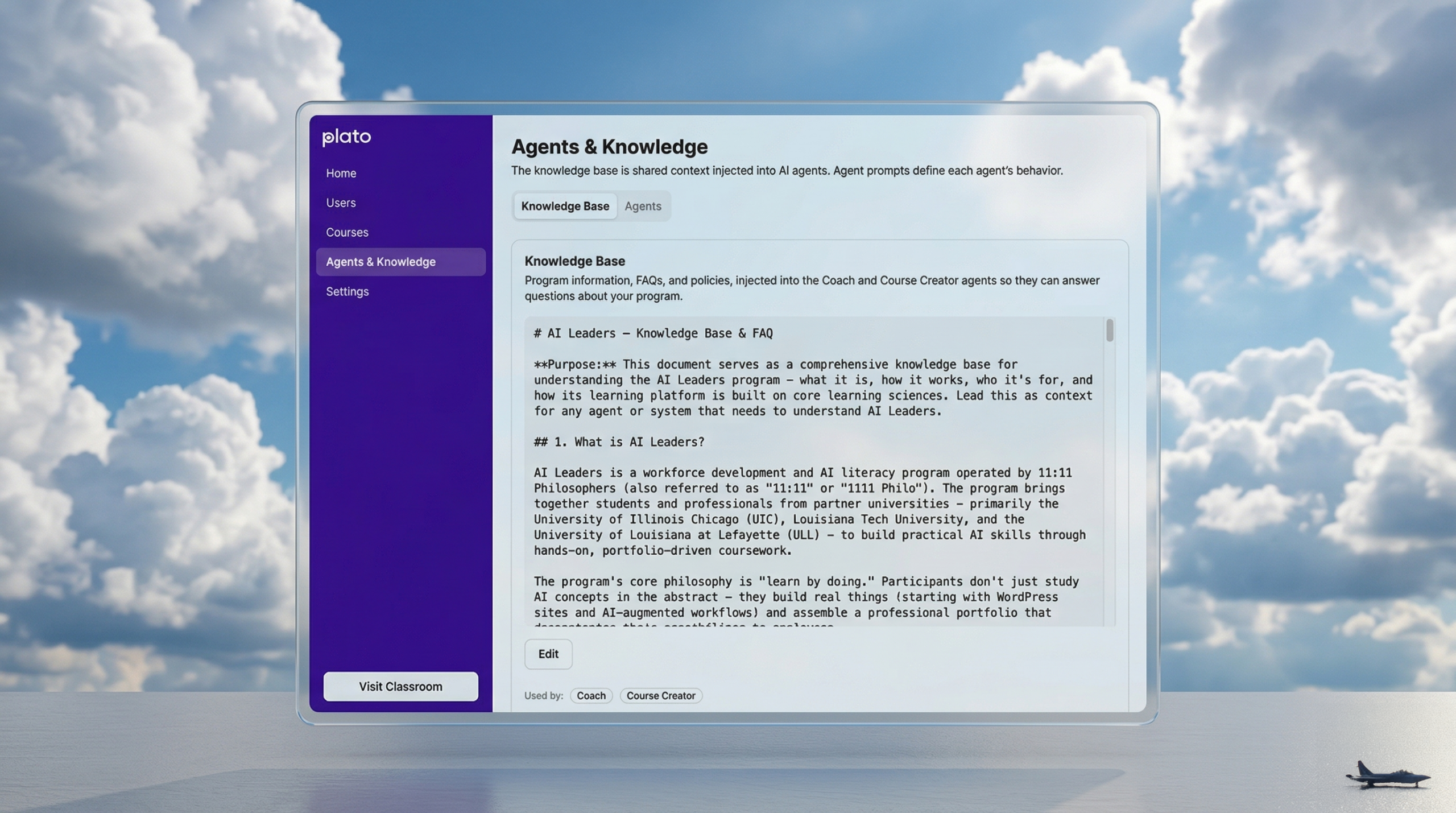
    screenshot of plato showing a modern interface with a page titled "agents and knowledge"

    At the center of plato is a learning loop, rooted in Learning Sciences. The learner is given activities by an AI coach, who constantly assesses their work as they move to a course exemplar. If the learner doesn’t grasp a concept, the coach offers questions that moves them closer to the exemplar.

    Educators can constantly tune the system by changing agent prompts, updating a knowledge base, or creating new courses. Each learner gets a little different experience, but the system makes sure every student reaches the Educator’s end goal.

    plato’s Moment

    PLATO — the original one — showed up sixty years too early. The hardware was not ready. The networks were not there. The culture had not caught up.

    Now, I’m betting that AI can help us scale education to a whole new generation of learners.

    If you are a developer, an educator, or someone who cares about what learning looks like in the next decade, I would love for you to take a look at the repository or get in touch with me.

    Like knowledge, plato belongs to everyone.
  • Introducing AI Leaders, and Why WordPress Matters

    Today, I’m launching AI Leaders.

    AI Leaders is a virtual AI Literacy course that gives 80 students the opportunity to earn living-wage WordPress jobs.

    WordPress is an amazing economic engine.

    When I was 17, I started using WordPress because I was tired of writing manual HTML to update sites. That shift changed my life. Over the next decade, I made a career building WordPress sites, but the real value wasn’t just money. WordPress allowed me to travel, experiment with art, and build new businesses.

    WordPress now powers over 40% of the internet and fuels a $590 billion economy. It isn’t just a blogging tool; it is a critical piece of global infrastructure.

    WordPress offers great new AI potential.

    WordPress projects like the Abilities API and MCP adapter add integration with Claude or ChatGPT, while the WordPress Playground makes way for Vibe Coding opportunities.

    Those projects are just a start.

    I’m sure a new generation of coders will make WordPress more efficient, easier to use, and feature rich with AI.

    To accelerate WordPress’ AI Future, I’ve teamed up with the WordPress Foundation, UIC, Louisiana Tech, and the Louisiana Educate Program to build AI Leaders.

    We are inviting 80 individuals from Illinois and Louisiana to turn their interest in AI into paid WordPress work. Participants will collaborate with mentors — including myself, Mary Hubbard (Executive Director of WordPress), and Stefin Pasternak — to build projects that demonstrate WordPress remains the most efficient tool for creative expression.

    WordPress has been good to me. By attracting and training new talent, WP can remain an economic engine for generations to come.

  • LaLeadsAI.org – AI Literacy Campaign

    LaLeadsAI.org – AI Literacy Campaign

    Happy to announce our AI Literacy campaign, LaLeadsAI.org, is now live. 

    I believe AI allows for more than just technical innovation. We can use AI to help societies, like Louisiana, pull up their bootstraps and lead. 

    Join us!

  • Reimagined Philanthropy: Take Action Now, Not Later

    Reimagined Philanthropy: Take Action Now, Not Later

    With 11:11 Philosopher’s Group (“1111”), I aim to build a public charity in the BRAC model. I work with domain experts to rapidly scale social impact ventures.

    By building bold ideas today, we can create a sustainable cycle of innovation that benefits communities in the long term.

    My first project was Equalify, an Open Source web accessibility platform. The project is now part of the University of Illinois Chicago (more info).

    With 1111, I’ve also launched NOAI, a festival to push innovation in New Orleans, a great city with a decreasing population. That festival is on track to reach sustainability by 2026.

    My next venture is AI Leaders, an Open Source GenAI learning platform. I am working with great partners from LSU, Tulane, WordPress, the Louisiana State Board of Elementary and Secondary Education (BESE), and many others.

    I will be announcing more on AI Leaders soon, and I invite you to contact me for more information.

    My superpower is bringing together people to create change. I’m always looking for new collaborators.

    PS: You can check out our 1111 Notion with more info about the work that led us to this point – lots of coffee shop convos!