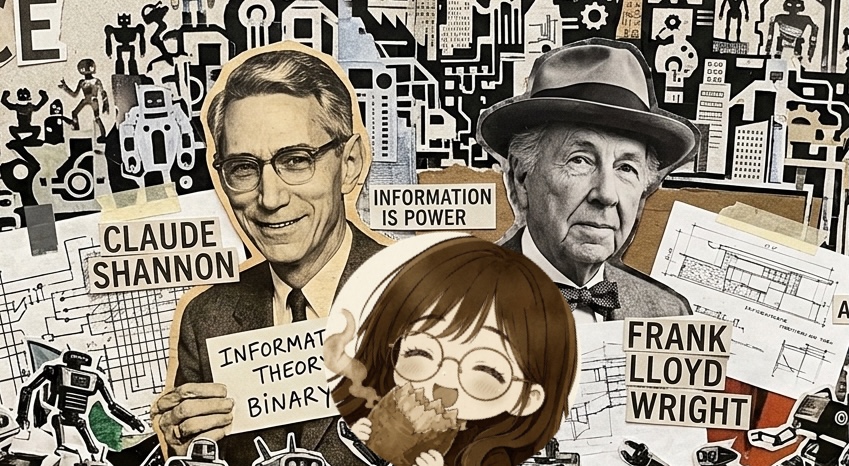

I put together this set of required readings for the AI, Arts, and Ideas festival I run (NOAI), but I think everyone should read these:
First: Claude Shannon’s one-page essay, The Bandwagon. Shannon founded information theory, helped launch AI as a field (he co-wrote the 1955 proposal for the Dartmouth workshop that coined the term), and is widely cited as the namesake of Anthropic’s Claude. In 1956, he wrote The Bandwagon to warn that his young discipline was being oversold.
Try this as you read: replace “information theory” with “AI.” Suddenly it’s a letter to our moment. Is AI mostly hype? Are we neglecting slow, serious research? Will AI prove transformative everywhere, or only in a handful of fields?
Shannon’s insistence on rigor reminded me of a second essay: How I Vibed a Proof of Conway’s Conjecture by Dan Abramov. Dan is known for co-creating Redux and for his work on React. He is not a mathematician. Should we take his proof seriously? His process closely mirrors how many big tech companies now build software using AI agents (see “How I Shipped 2,000 PRs Last Month — Trusting AI Agents”).
We can clearly reach ambitious results without understanding every step that got us there. But should we? What do we risk when we can’t explain how something works?
My hunch: We need both dreamers and builders. Architects and engineers.
Last week, a visitor touring a Frank Lloyd Wright house was killed when high winds tore loose roofing material. Did Frank Lloyd Wright rely on as many engineers as he should’ve? Could experienced engineering have saved a life?
The roof incident left me wondering how many decisions we’re making about AI right now without understanding the basics of what agents are doing. Blind trust and ambition seem to be the operating principles of our AI age.
As AI reshapes how we work, create, and think, I hope we’ll all weigh both its dangers and its potential. The best response isn’t blind faith or blanket rejection. It’s experimentation, with our eyes open. I hope these readings leave you curious and open to whatever comes next.
Leave a Reply